
HIGHLIGHTS FROM THIS STUDY
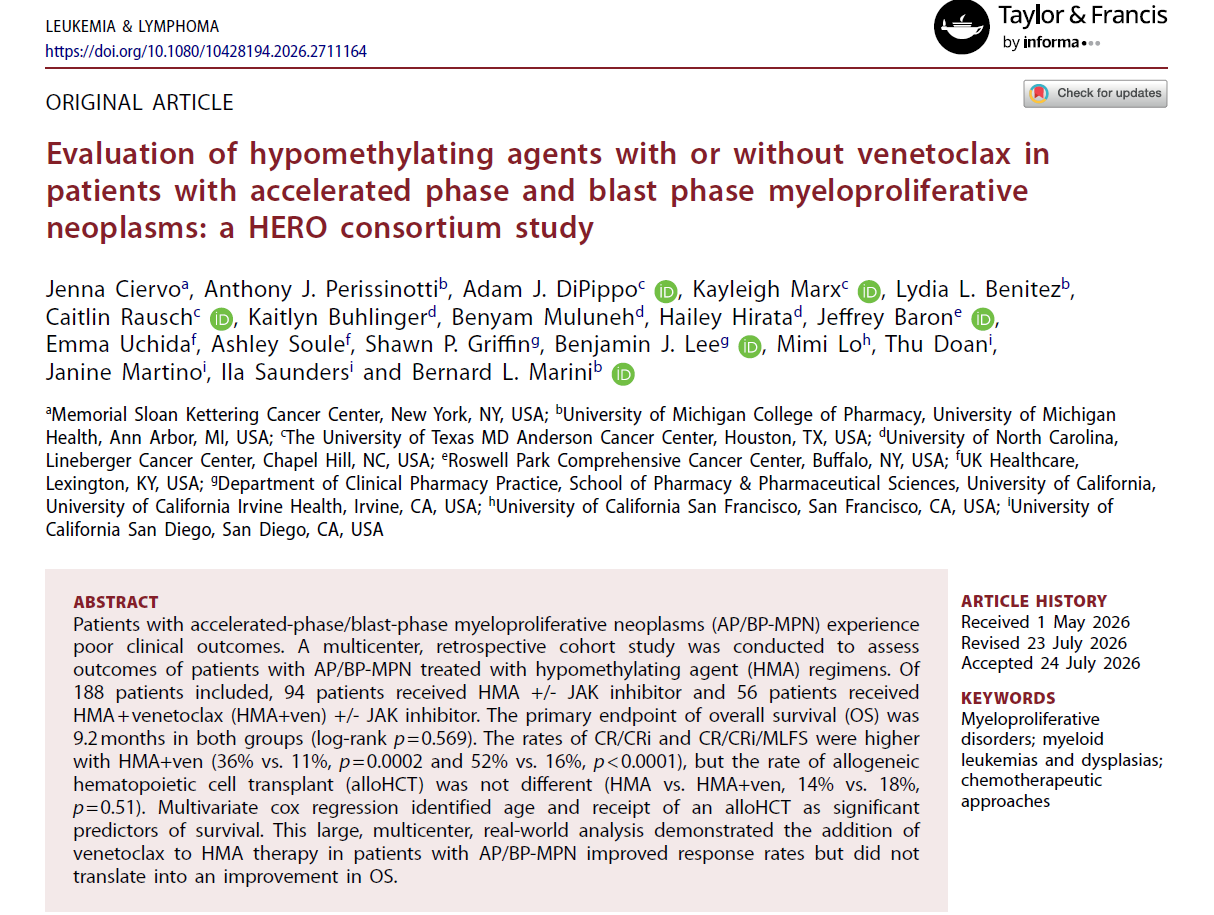
One of the largest real-world studies ever conducted in this rare, high-risk population. Through the HERO Consortium's network of nine U.S. cancer centers, investigators assembled 188 patients with accelerated- and blast-phase myeloproliferative neoplasms (AP/BP-MPN) — a group so uncommon and so often excluded from clinical trials that high-quality data have been almost impossible to generate at any single institution.
Adding venetoclax to hypomethylating therapy more than tripled response rates. Complete response rates (CR/CRi) jumped from 11% to 36%, and overall response (CR/CRi/MLFS) rose from 16% to 52% — both highly statistically significant.
Better responses did not mean longer lives. Despite the dramatic improvement in remission rates, median overall survival was identical at 9.2 months in both groups. This response-versus-survival disconnect is a critical, practice-relevant finding that challenges the routine addition of venetoclax in this setting.
Transplant and younger age — not drug intensity — drove survival. Patients who received an allogeneic transplant lived a median of 22 months versus roughly 9 months for those who did not, reinforcing where the real survival gains lie.
A model for what collaborative pharmacy-led research can accomplish. By pooling de-identified data across institutions under the HERO Consortium's unfunded, investigator-driven framework, this study delivered rigorous, real-world evidence that no single center could have produced alone — directly informing how clinicians weigh treatment decisions for a population that guidelines still can't clearly address.
Link to Pub
HIGHLIGHTS FROM THIS STUDY
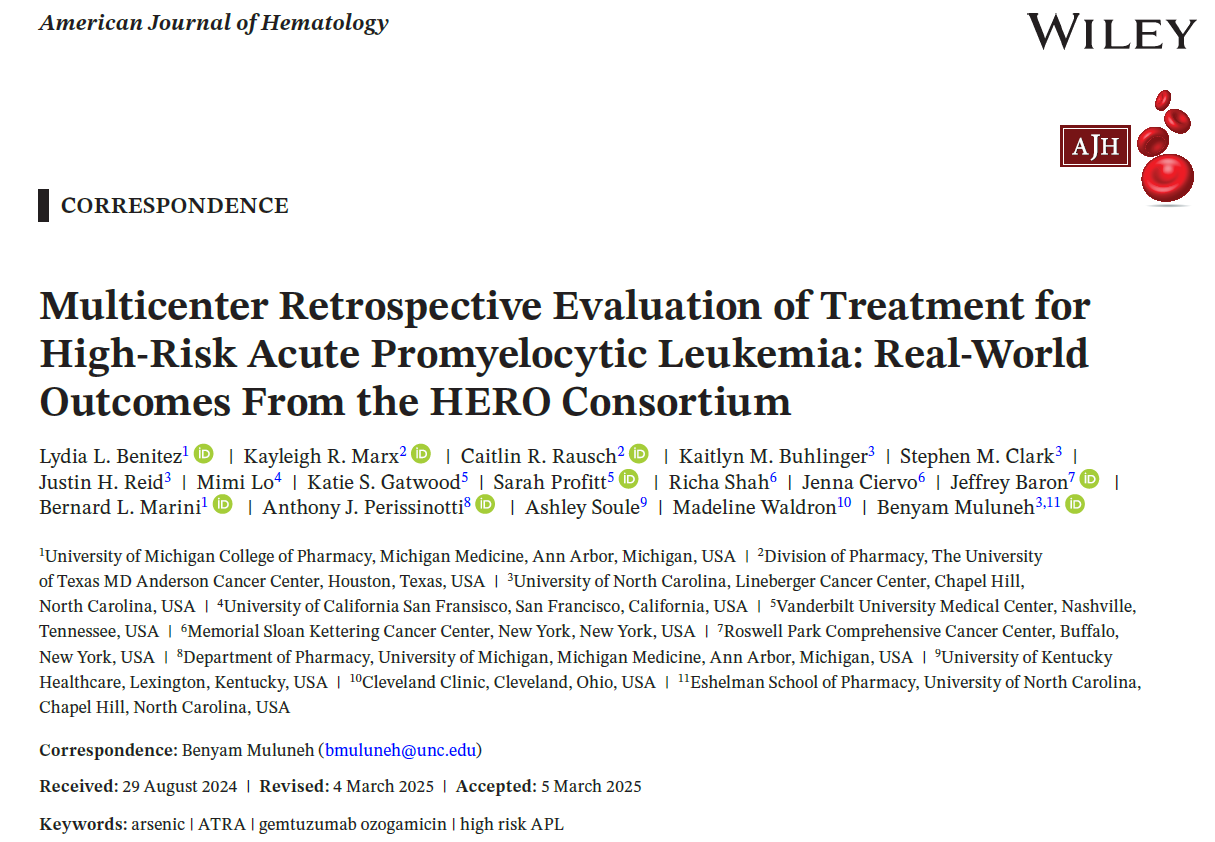
The first-ever head-to-head comparison of the two guideline-recommended regimens for high-risk APL. Leveraging the HERO Consortium's nine-center network, investigators compared APML4 against ATRA+ATO+gemtuzumab ozogamicin (GO) in 77 patients — a comparison never before reported, made possible only by pooling real-world experience across institutions for this rare leukemia.
Both regimens delivered outstanding cure rates — but the GO-based approach was easier on patients. Complete remission rates were excellent in both arms (90% vs. 96%), with 36-month survival exceeding 90%. Critically, the ATRA+ATO+GO regimen — which used less anthracycline and shorter arsenic therapy — was associated with faster blood count recovery and fewer episodes of neutropenic fever, pointing toward less toxic, more patient-centered care.
Real-world evidence that only the HERO Consortium could generate. By uniting hematology-oncology pharmacists across nine major U.S. cancer centers, this collaborative, investigator-driven study produced the first comparative data to guide treatment selection in high-risk APL — filling a critical evidence gap for a disease too rare for any single center to study alone.
Link to Pub